Three counts of time
Interlocking wheels of days, still kept by K’iche’ daykeepers in the highlands of Guatemala.
- 260 daysTzolk’in, or Cholq’ij
- The sacred round of 20 day-signs and 13 tones: the count of your Mayan sign.
- 365 daysHaab’
- The solar year of 18 months of 20 days, plus the 5 days of Wayeb’.
- 52 yearsCalendar Round
- The span after which the Tzolk’in and the Haab’ meet again on the same day.
- 5,125 yearsLong Count
- Historical time in base 20 from the era date 13.0.0.0.0, correlated with GMT 584,283.
_female_Piquiri_River_2.JPG?width=1800)
Animals
- JaguarPanthera oncaNear threatened (IUCN)
- Baird's tapirTapirus bairdiiEndangered (IUCN)
- Keel-billed toucanRamphastos sulfuratusNative to the Maya forest
- Geoffroy's spider monkeyAteles geoffroyiEndangered (IUCN)
- Resplendent quetzalPharomachrus mocinnoNear threatened (IUCN)
- Yucatán black howlerAlouatta pigraEndangered (IUCN)
- Ocellated turkeyMeleagris ocellataNear threatened (IUCN)
- Melipona beeMelipona beecheiiKept by Maya families for millennia
.jpg?width=1800)
Plants
- CeibaCeiba pentandraYaxche', the world tree
- MaizeZea maysThe grain from which people were made
- CacaoTheobroma cacaoDrink of the gods and currency
- ChicozapoteManilkara zapotaSource of chicle
- Ramón (breadnut)Brosimum alicastrumA food tree of the forest
- MahoganySwietenia macrophyllaGreat timber tree of the Petén
- CopalProtium copalResin burned in ceremonies
- ChayaCnidoscolus aconitifoliusLeafy green of the milpa

Remedies
- Melipona honeyMelipona beecheiiTraditionally used on the eyes and on wounds
- Guava leafPsidium guajavaTraditionally used as a tea for the stomach
- EpazoteDysphania ambrosioidesTraditionally used for digestion
- MuicleJusticia spicigeraTraditionally used as a tonic tea
- Copal smokeProtium copalUsed to cleanse spaces in healing ceremonies
- ChayaCnidoscolus aconitifoliusValued as a nourishing cooked green
Mayan Culture · 03
Library of Nature
Traditional knowledge of living communities, shared for culture and study. It is not medical advice.

Cultural Archive · 04
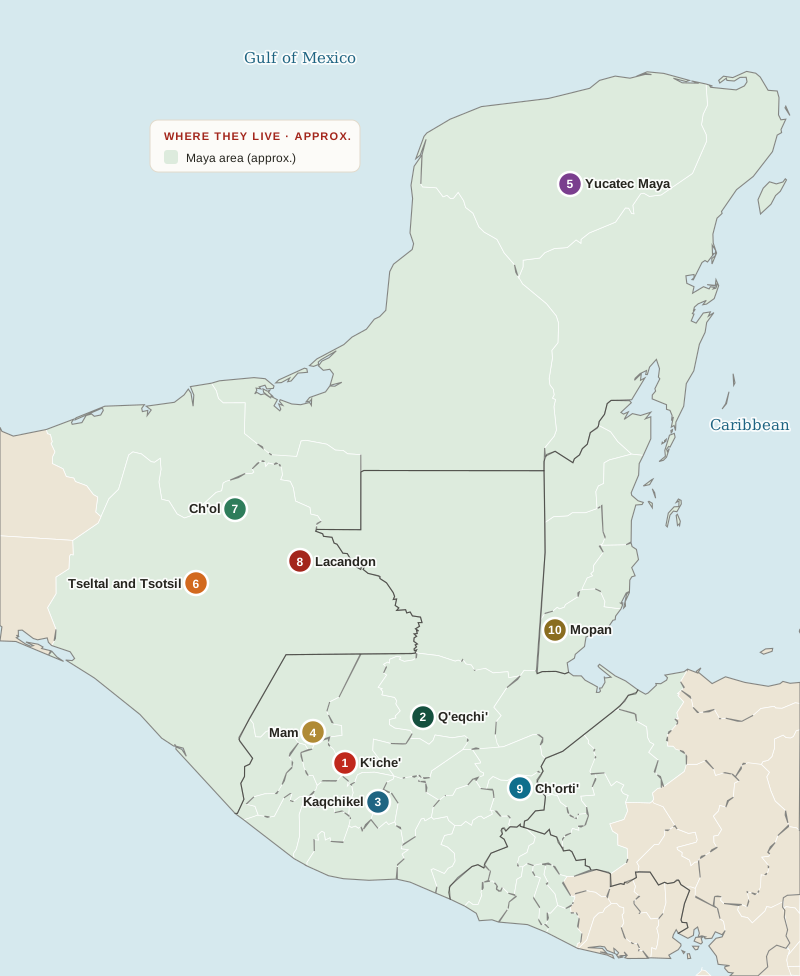
Many Maya peoples
- 1K'iche'
- 2Q'eqchi'
- 3Kaqchikel
- 4Mam
- 5Yucatec Maya
- 6Tseltal and Tsotsil
- 7Ch'ol
- 8Lacandon
- 9Ch'orti'
- 10Mopan
El Castillo, Chichén Itzá
.jpg?width=2000)


The Maya world in brief
The Mayan Bioregional Library covers the Maya area of Mesoamerica: about 324,000 square kilometres.
The Mayan Bioregional Library covers the Maya area of Mesoamerica: about 324,000 square kilometres (32,400,000 hectares / 80,060,000 acres) across south-east Mexico, Guatemala, Belize and the western edges of Honduras and El Salvador. It runs from the limestone plain of the Yucatán Peninsula to the volcanic highlands of Chiapas and Guatemala, with the Caribbean coast and the Mesoamerican Reef to the east (area as commonly given for the Maya area in Britannica and archaeological atlases).
The Mayan LibraryMayan Culture · NEO Encyclopedia
- Area
- ≈ 324,000 km² · 32.4 million ha · 80 million acres
- Countries
- Mexico (Yucatán, Campeche, Quintana Roo, Chiapas, Tabasco), Guatemala, Belize, western Honduras and El Salvador
- Maya people today
- About 8 million (estimate): 6.2 million in Guatemala (census 2018) and about 2.4 million speakers of Mayan languages in Mexico (census 2020)
- Languages
- About 30 Mayan languages, among them Yucatec, K'iche', Q'eqchi', Kaqchikel, Mam, Tseltal, Tsotsil and Ch'ol
- Protected forest
- Gran Selva Maya biocultural corridor: about 5.7 million ha in Mexico, Guatemala and Belize (2025)
- World Heritage
- Tikal, Calakmul, Palenque, Chichén Itzá, Uxmal, Copán and Joya de Cerén, among others
- Time
- Tzolk'in (260 days), Haab' (365 days) and the Long Count
- Writing
- A logosyllabic script of hundreds of signs; four codices survive
- Economy
- Milpa farming, coffee, honey, textiles and crafts, tourism
- Arts
- Backstrap-loom weaving and huipiles, murals, ceramics, the marimba
- Symbols
- The ceiba (world tree), the jaguar, the quetzal, the colors of the four directions
Sources: INE Guatemala (Censo 2018), INEGI (Censo 2020), Britannica, UNESCO World Heritage Centre, Gran Selva Maya. All references
The sign of a day in the Tzolk’in
Choose a date
Pick any date to see its day-sign and tone.
Counting in twenties
A dot is one, a bar is five and a shell is zero. With three signs the Maya wrote every number, and used zero centuries before Europe. Explore the Numbers Library or the symbols report.
- 0Mi
- 1Hun
- 2Ka’a
- 3Oox
- 4Kan
- 5Ho’
- 6Wak
- 7Wuk
- 8Waxak
- 9Bolon
- 10Lajun
- 11Buluk
- 12Lajka’a
- 13Oxlajun
- 14Kanlajun
- 15Ho’lajun
- 16Waklajun
- 17Wuklajun
- 18Waxaklajun
- 19Bolonlajun
- 20Jun Kal
The twenty day-signs
From Imix to Ajaw, read in four groups of five. Each group belongs to a direction of the world and carries its color.


SouthNohol. Yellow, growth and abundance.


No day-sign matches that search.
The four surviving books
Painted on bark paper folded like a screen, four Maya codices survive. They hold astronomy, calendars, ritual and prophecy: the oldest books of the Americas.
Dresden Codex (search, opens in a new tab)
Venus tables, eclipse tables and the most refined Maya astronomy.
Madrid Codex (search, opens in a new tab)
Almanacs for farming, hunting, beekeeping and rain.
Paris Codex (search, opens in a new tab)
K’atun prophecies and a sky of constellations.
Maya Codex of Mexico (search, opens in a new tab)
Formerly the Grolier; authenticated by INAH in 2018 as the oldest of the four.
The catalog
Forty subjects of the Maya world, arranged like a periodic table. Open any element to read its catalog card.
- Time and sky
- Writing and knowledge
- Land and people
- Arts and life
- Sources and media
Time and sky, element 1
Mayan Calendar
The Maya kept interlocking counts of time: the 260-day Tzolk’in, the 365-day Haab’ and the Long Count for historical dates.
Read: The Mayan CalendarSearch the library (opens in a new tab)
Time and sky, element 2
Tzolk’in
Twenty day-signs combined with thirteen numbers make the sacred 260-day round, still kept today by K’iche’ daykeepers (Ajq’ijab’) in Guatemala.
Time and sky, element 3
Haab’
The solar year of 18 months of 20 days, plus the 5 days of Wayeb’. Its months include Pop, Sotz’, Yaxk’in and K’ank’in.
Time and sky, element 4
Long Count
Counts days in base 20 (k’in, winal, tun, k’atun, b’ak’tun) from the era date 13.0.0.0.0 4 Ajaw 8 Kumk’u — 11 August 3114 BCE in the GMT correlation.
Time and sky, element 5
Day-signs
From Imix to Ajaw: the 20 day-signs, read in four groups of five, one for each direction of the world.
Time and sky, element 6
Your Mayan sign
Your sign is the day-sign and tone of the day you were born in the Tzolk’in. Calculate it instantly with the calculator at the top of this page.
Read: How to calculate your signSearch the library (opens in a new tab)
Time and sky, element 7
Astronomy
Maya astronomers followed the Sun, the Moon and Venus with naked-eye precision. Buildings such as El Caracol at Chichén Itzá are linked to sky observation.
Time and sky, element 8
Venus & eclipses
The Venus table of the Dresden Codex follows the 584-day cycle of Venus, and its eclipse table warns of possible eclipses.
Time and sky, element 9
Cosmology
Three levels of the world: the sky of 13 layers, the earth, and Xibalba, the underworld of 9 levels, joined by the ceiba, the world tree.
Writing and knowledge, element 10
Codices
Four Maya books survive: the Dresden, Madrid and Paris codices and the Maya Codex of Mexico, painted on folded bark paper.
Writing and knowledge, element 11
Numbers
Base 20 with three signs: the dot (1), the bar (5) and the shell (0) — one of the earliest uses of zero in history.
Open the Numbers LibrarySearch the library (opens in a new tab)
Writing and knowledge, element 12
Symbols report
Every Mayan number from 0 to 20 with its name, symbol and meaning, in one report.
Writing and knowledge, element 13
Sign meanings
What each of the 20 day-signs symbolizes: its element, animal, direction and energy.
Writing and knowledge, element 14
Hieroglyphic writing
A logosyllabic script of word-signs and syllables, with hundreds of known signs. Its decipherment advanced from the 1950s with Yuri Knorozov and Tatiana Proskouriakoff.
Writing and knowledge, element 15
Popol Vuh
The K’iche’ book of counsel: creation of the world, the Hero Twins Hunahpu and Xbalanque, and the people of maize. Copied by Francisco Ximénez around 1701.
Writing and knowledge, element 16
Mayan languages
Around thirty Mayan languages are spoken today — among them Yucatec, K’iche’, Q’eqchi’, Kaqchikel, Mam and Tzeltal — by millions of people.
Land and people, element 17
NEO MAP
The interactive map of the Maya Bioregion, land and sea: archaeological zones, protected areas, cenotes, museums, routes and a visit planner.
Land and people, element 18
Gran Selva Maya
The biocultural corridor created on 15 August 2025 by Mexico, Guatemala and Belize: about 5.7 million hectares and 50 protected areas.
Visit granselvamaya.orgSearch the library (opens in a new tab)
Land and people, element 19
Archaeological sites
Tikal, Calakmul, Palenque, Copán, Chichén Itzá, Uxmal, Ek’ Balam and Tulum are among the great cities of the Maya world.
Land and people, element 20
Cenotes
Natural wells in the limestone of the Yucatán Peninsula: the main source of fresh water and sacred entrances to Xibalba, the underworld.
Land and people, element 21
Population
Millions of Maya people live today in Mexico, Guatemala, Belize, Honduras and El Salvador — a living civilization, not a lost one.
Land and people, element 22
Extension & territory
The Maya area covers about 324,000 km²: the Yucatán Peninsula, Chiapas and Tabasco, Guatemala, Belize and the west of Honduras and El Salvador.
Land and people, element 23
Communities
Living Maya communities keep their languages, the milpa, weaving and the 260-day count of the daykeepers.
Land and people, element 24
Daykeepers
The Ajq’ijab’ are K’iche’ spiritual guides who keep the count of the days and lead ceremonies in the highlands of Guatemala.
Arts and life, element 25
Architecture
Stepped pyramids, corbelled vaults, palaces, ball courts and white roads (sakbe’ob), with regional styles such as Petén, Río Bec, Chenes and Puuc.
Arts and life, element 26
Archaeology
Lidar surveys since 2018 have revealed tens of thousands of structures hidden under the forest of the Petén and Campeche.
Arts and life, element 27
Ball game
Pitz, the Maya ball game, was played with a solid rubber ball on I-shaped courts; the Great Ball Court of Chichén Itzá is the largest known.
Arts and life, element 28
Music
The murals of Bonampak show processions with drums, trumpets and rattles: music accompanied ritual, dance and war.
Arts and life, element 29
Instruments
Tunkul slit drums, turtle-shell drums, conch and wooden trumpets, clay flutes, ocarinas and rattles; today also the marimba.
Arts and life, element 30
Festivities
Hanal Pixán, the Day of the Dead in Yucatán; the five Wayeb’ days; the Rabinal Achí dance-drama, recognized by UNESCO.
Arts and life, element 31
Gastronomy
The milpa of maize, beans, squash and chili; cacao; cochinita pibil cooked in the pib, the earth oven.
Arts and life, element 32
Textiles & crafts
Backstrap-loom weaving and embroidered huipiles whose designs identify each community.
Arts and life, element 33
Colors & symbols
Maya blue, made of indigo and palygorskite clay; and the colors of the directions: red (east), white (north), black (west), yellow (south).
See the four directionsSearch the library (opens in a new tab)
Arts and life, element 34
Medicine & plants
Traditional healers (h-men) work with plants such as chaya and with copal resin in ceremonies, a knowledge carried by living people.
Sources and media, element 35
Library articles
All the articles of the Mayan Library: signs, numbers, calendar and culture.
Sources and media, element 36
Bibliography
Essential reading: Michael D. Coe, Breaking the Maya Code; Linda Schele and David Freidel, A Forest of Kings; Dennis Tedlock (trans.), Popol Vuh.
Sources and media, element 37
Filmography
Documentaries: Breaking the Maya Code (David Lebrun, 2008) and Lost Treasures of the Maya Snake Kings (National Geographic, 2018).
Sources and media, element 38
Photography
Teobert Maler and Alfred Maudslay photographed Maya cities in the 19th century; Justin Kerr’s rollout photographs record hundreds of Maya vases.
Sources and media, element 39
Maps & cartography
NEO MAP is the cartography of NEO Library: maps conceived as library pieces that describe, order and cite.
Sources and media, element 40
The method
The library is built on library science from the UNAM thesis of Sánchez González, José Fernando.
NEO Glossary
The key terms of this library, defined in plain words.
- Tzolk'in
- The sacred count of 260 days: 20 day-signs combined with 13 numbers.
- Haab'
- The solar year of 18 months of 20 days plus the 5 days of Wayeb'.
- Long Count
- A count of days in base 20 from the era date 13.0.0.0.0, used for historical dates.
- Wayeb'
- The five closing days of the Haab', a time of caution.
- Nawal (Nahual)
- The day-sign and spirit companion that guides a person from birth.
- Ajq'ij
- A K'iche' daykeeper who keeps the count of days and leads ceremonies.
- Ajaw
- Lord; also the twentieth day-sign, the Sun.
- K'atun
- A period of 20 years of 360 days in the Long Count.
- Xibalba
- The underworld, entered through caves and cenotes.
- Ceiba (Yaxche')
- The world tree that joins sky, earth and underworld.
- Milpa
- The field of maize, beans and squash grown together.
- Cenote
- A natural well in the limestone of the Yucatán Peninsula.
- Sakbe
- A raised white road joining Maya cities.
- Huipil
- A woven blouse whose designs identify each community.
- Popol Vuh
- The K'iche' book of creation, the Hero Twins and the people of maize.
References and sources
Official and academic sources behind the figures and facts of this library.
- Instituto Nacional de Estadística, Guatemala · Censo 2018 (opens in a new tab)
- INEGI · Censo de Población y Vivienda 2020 (opens in a new tab)
- INALI · Catálogo de las Lenguas Indígenas Nacionales (opens in a new tab)
- Instituto Nacional de Antropología e Historia (INAH) (opens in a new tab)
- UNESCO World Heritage Centre · Mexico, Guatemala, Belize, Honduras, El Salvador (opens in a new tab)
- Smithsonian National Museum of the American Indian · Living Maya Time (opens in a new tab)
- Encyclopaedia Britannica · Maya (opens in a new tab)
- Gran Selva Maya biocultural corridor (opens in a new tab)
- Sánchez González, José Fernando · UNAM thesis (method of NEO Library) (opens in a new tab)
Index of terms
C
M
P
Z
Questions readers ask
What is a Mayan day-sign?
Can I see my day-sign right now?
What is the Tzolk’in and why 260 days?
What is NEO MAP?
What are the Maya codices?
Can I make the text bigger?
Readings of the world
Every NEO library keeps the reading of its own culture and the map of its own bioregion. One world, read by bioregion.
Masthead
The Mayan Library is the flagship library of NEO Library, the new library for the new civilization.
- Librarian
- Joséf Sánchez Coach
Librarian (UNAM), author of the library and of NEO MAP.
- The forest
- Gran Selva Maya
About 5.7 million hectares across Mexico, Guatemala and Belize.
- The method
- The UNAM thesis
Library science from the thesis of Sánchez González, José Fernando.
- Technology
- SESY.AI
Built and hosted with SESY.AI, Semantic Systems & AI.
Keep the library free
Open maps and an open archive are sustained entirely by readers. Every contribution keeps this knowledge free for everyone.
Contributions go to Joséf Sánchez, individual (persona física) registered in Mexico; they are not tax-deductible.
Colophon
Mayan knowledge
Authorship. Research, writing and Digital Cartography by Librarian Joséf Sánchez Coach. Made with the help of the artificial intelligences of the world, Claude among them, as research and drafting tools; every text, figure and map was selected, verified and signed by the author. NEO Atlas maps are a Sesy Maps product (SESY.AI).
Set in Bodoni Moda and Jost (SIL Open Font License). Day-sign glyphs from Maya glyphs of days, Wikimedia Commons; see each file for its author and license. Maya numerals and calendar wheels drawn for NEO Library. Map tiles © Esri and OpenStreetMap contributors, rendered with Leaflet. Editor and librarian: Joséf Sánchez Coach, Colegio de Bibliotecología, UNAM.