Mayan Atlas
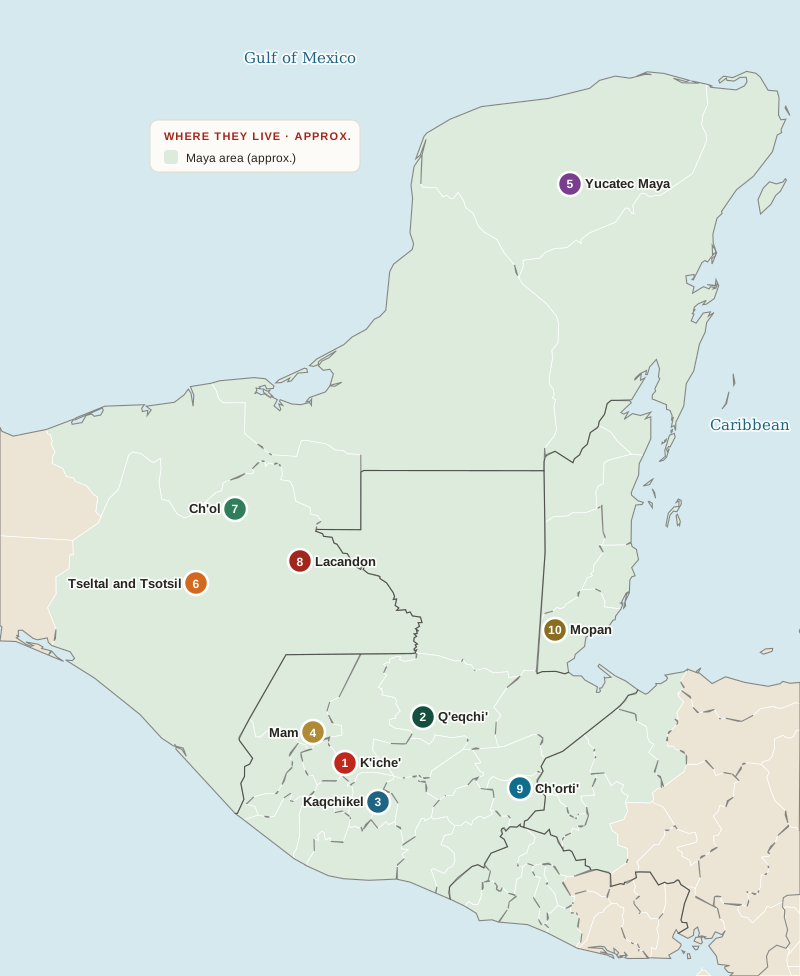
Open MapCartography by Joséf Sánchez · 2026.jpg?width=2000)


The Mayan Bioregional Library covers the Maya area of Mesoamerica: about 324,000 square kilometres.
The Mayan Bioregional Library covers the Maya area of Mesoamerica: about 324,000 square kilometres (32,400,000 hectares / 80,060,000 acres) across south-east Mexico, Guatemala, Belize and the western edges of Honduras and El Salvador. It runs from the limestone plain of the Yucatán Peninsula to the volcanic highlands of Chiapas and Guatemala, with the Caribbean coast and the Mesoamerican Reef to the east (area as commonly given for the Maya area in Britannica and archaeological atlases).
Mayan Archive: The Maya world in brief
NEO Almanac · The Mayan Library
- Area324,000 km²Five countries, one Maya world
- Maya people≈ 8 millionThe living Maya of today
- Languages30Mayan languages spoken today
- Forest5.7 M haGran Selva Maya corridor
- World Heritage7+Tikal, Calakmul, Palenque, Chichén Itzá…
- Time260 · 365The Tzolk'in and the Haab'
Sources: INE Guatemala (Censo 2018), INEGI (Censo 2020), Britannica, UNESCO World Heritage Centre, Gran Selva Maya. All references
- Area
- ≈ 324,000 km² · 32.4 million ha · 80 million acres
- Countries
- Mexico (Yucatán, Campeche, Quintana Roo, Chiapas, Tabasco), Guatemala, Belize, western Honduras and El Salvador
- Maya people today
- About 8 million (estimate): 6.2 million in Guatemala (census 2018) and about 2.4 million speakers of Mayan languages in Mexico (census 2020)
- Languages
- About 30 Mayan languages, among them Yucatec, K'iche', Q'eqchi', Kaqchikel, Mam, Tseltal, Tsotsil and Ch'ol
- Protected forest
- Gran Selva Maya biocultural corridor: about 5.7 million ha in Mexico, Guatemala and Belize (2025)
- World Heritage
- Tikal, Calakmul, Palenque, Chichén Itzá, Uxmal, Copán and Joya de Cerén, among others
- Time
- Tzolk'in (260 days), Haab' (365 days) and the Long Count
- Writing
- A logosyllabic script of hundreds of signs; four codices survive
- Economy
- Milpa farming, coffee, honey, textiles and crafts, tourism
- Arts
- Backstrap-loom weaving and huipiles, murals, ceramics, the marimba
- Symbols
- The ceiba (world tree), the jaguar, the quetzal, the colors of the four directions
Mayan Codices & Books
Painted on bark paper folded like a screen, four Maya codices survive. They hold astronomy, calendars, ritual and prophecy: the oldest books of the Americas.
_female_Piquiri_River_2.JPG?width=1800)
Animals
- JaguarPanthera oncaNear threatened (IUCN)
- Baird's tapirTapirus bairdiiEndangered (IUCN)
- Keel-billed toucanRamphastos sulfuratusNative to the Maya forest
- Geoffroy's spider monkeyAteles geoffroyiEndangered (IUCN)
- Resplendent quetzalPharomachrus mocinnoNear threatened (IUCN)
- Yucatán black howlerAlouatta pigraEndangered (IUCN)
- Ocellated turkeyMeleagris ocellataNear threatened (IUCN)
- Melipona beeMelipona beecheiiKept by Maya families for millennia
.jpg?width=1800)
Plants
- CeibaCeiba pentandraYaxche', the world tree
- MaizeZea maysThe grain from which people were made
- CacaoTheobroma cacaoDrink of the gods and currency
- ChicozapoteManilkara zapotaSource of chicle
- Ramón (breadnut)Brosimum alicastrumA food tree of the forest
- MahoganySwietenia macrophyllaGreat timber tree of the Petén
- CopalProtium copalResin burned in ceremonies
- ChayaCnidoscolus aconitifoliusLeafy green of the milpa

Remedies
- Melipona honeyMelipona beecheiiTraditionally used on the eyes and on wounds
- Guava leafPsidium guajavaTraditionally used as a tea for the stomach
- EpazoteDysphania ambrosioidesTraditionally used for digestion
- MuicleJusticia spicigeraTraditionally used as a tonic tea
- Copal smokeProtium copalUsed to cleanse spaces in healing ceremonies
- ChayaCnidoscolus aconitifoliusValued as a nourishing cooked green
Mayan Nature Library
Traditional knowledge of living communities, shared for culture and study. It is not medical advice.
Mayan Species
Mayan Culture Library: peoples and language families
- Yucatecan
- Ch'olan
- Tseltalan
- Q'anjob'alan
- Mamean
- K'iche'an
- Huastecan
The Maya are not one people but many related peoples who share a language family and a long history. Their cosmology shares common threads: a world of three levels (the sky, the earth and Xibalba, the underworld) joined by the ceiba tree; four directions with their colors; and time counted in interlocking cycles kept by daykeepers.
- Yucatec Maya · Yucatecan
- Lacandon · Yucatecan
- Itza' · Yucatecan
- Mopan · Yucatecan
- Ch'ol · Ch'olan
- Chontal (Yokot'an) · Ch'olan
- Ch'orti' · Ch'olan
- Tseltal · Tseltalan
- Tsotsil · Tseltalan
- Tojolabal · Q'anjob'alan
- Chuj · Q'anjob'alan
- Q'anjob'al · Q'anjob'alan
- Akateko · Q'anjob'alan
- Jakalteko (Popti') · Q'anjob'alan
- Mam · Mamean
- Tektiteko · Mamean
- Awakateko · Mamean
- Ixil · Mamean
- Sakapulteko · K'iche'an
- Sipakapense · K'iche'an
- K'iche' · K'iche'an
- Uspanteko · K'iche'an
- Tz'utujil · K'iche'an
- Kaqchikel · K'iche'an
- Achi · K'iche'an
- Poqomchi' · K'iche'an
- Poqomam · K'iche'an
- Q'eqchi' · K'iche'an
- Teenek (Huastec) · Huastecan
- Qato'k (Mocho') · Q'anjob'alan
Mayan Gastronomy
Mayan Philosophy
The sign of a day in the Tzolk’in
Choose a date
Pick any date to see its day-sign and tone.
Mayan Science Library · Mayan Calendar · Three counts of time
Interlocking wheels of days, still kept by K’iche’ daykeepers in the highlands of Guatemala.
- 260 daysTzolk’in, or Cholq’ij
- The sacred round of 20 day-signs and 13 tones: the count of your Mayan sign.
- 365 daysHaab’
- The solar year of 18 months of 20 days, plus the 5 days of Wayeb’.
- 52 yearsCalendar Round
- The span after which the Tzolk’in and the Haab’ meet again on the same day.
- 5,125 yearsLong Count
- Historical time in base 20 from the era date 13.0.0.0.0, correlated with GMT 584,283.
Mayan Signs · The twenty day-signs
From Imix to Ajaw, read in four groups of five. Each group belongs to a direction of the world and carries its color.
EastLikin. Red, where the sun is born.


NorthXaman. White, the ancestors and wisdom.


WestChikin. Black, where the sun descends.


SouthNohol. Yellow, growth and abundance.


No day-sign matches that search.
Mayan Numbers · Counting in twenties
A dot is one, a bar is five and a shell is zero. With three signs the Maya wrote every number, and used zero centuries before Europe. Explore the Numbers Library or the symbols report.
Mayan Art Library · Mayan Art
References and sources
Official and academic sources behind the figures and facts of this library.
- Instituto Nacional de Estadística, Guatemala · Censo 2018 (opens in a new tab)
- INEGI · Censo de Población y Vivienda 2020 (opens in a new tab)
- INALI · Catálogo de las Lenguas Indígenas Nacionales (opens in a new tab)
- Instituto Nacional de Antropología e Historia (INAH) (opens in a new tab)
- UNESCO World Heritage Centre · Mexico, Guatemala, Belize, Honduras, El Salvador (opens in a new tab)
- Smithsonian National Museum of the American Indian · Living Maya Time (opens in a new tab)
- Encyclopaedia Britannica · Maya (opens in a new tab)
- Gran Selva Maya biocultural corridor (opens in a new tab)
- Sánchez González, José Fernando · UNAM thesis (method of NEO Library) (opens in a new tab)
Colophon
Mayan knowledge
Authorship. Research, writing and cartography by Joséf Sánchez. Made with the help of the artificial intelligences of the world, Claude among them, as research and drafting tools; every text, figure and map was selected, verified and signed by the author. NEO Atlas maps are a Sesy Maps product (SESY.AI).
Set in Bodoni Moda and Jost (SIL Open Font License). Day-sign glyphs from Maya glyphs of days, Wikimedia Commons; see each file for its author and license. Maya numerals and calendar wheels drawn for NEO Library. Map tiles © Esri and OpenStreetMap contributors, rendered with Leaflet. Editor and librarian: Joséf Sánchez Coach, Colegio de Bibliotecología, UNAM.